
Google AI Inbox Is Transforming Gmail: What Businesses Need to Know
Google is moving Gmail beyond the traditional email inbox.
The new Google AI Inbox, powered by Gemini, is designed to help users identify important messages, understand what requires attention, and respond more efficiently. Instead of forcing people to scan every email in chronological order, Gmail can now organize messages by priority, action items, deadlines, and topics.
For business owners, executives, marketers, and client service teams, this represents more than another Gmail feature. It signals a broader shift toward AI-managed communication.
What Is Google AI Inbox?
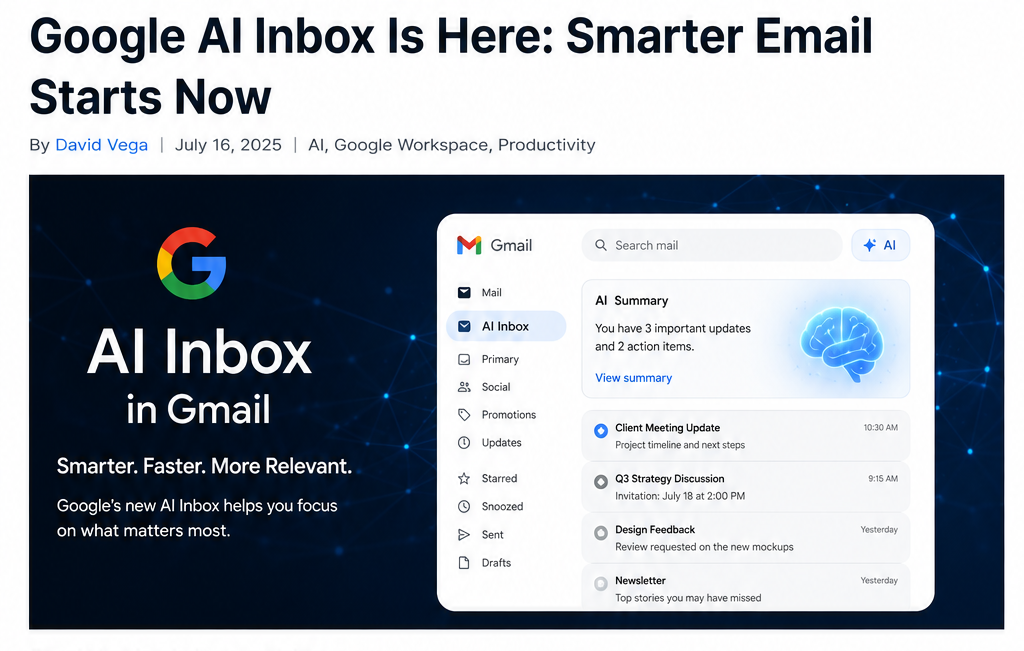
AI Inbox is a new view in Gmail that uses Google’s Gemini technology to determine what matters most to the user.
Rather than presenting email as a single long stream of messages, AI Inbox can surface urgent tasks, summarize key developments, group related conversations, and highlight information that may require a response.
Google is effectively turning Gmail into a more proactive personal assistant. The inbox no longer waits for you to decide what deserves attention. It helps identify where your attention may be needed.
How Google AI Inbox Works
AI Inbox analyzes the context within your email activity and creates a simplified view of important information. Depending on your account and available features, Gmail may identify tasks, display important updates, summarize conversations, and prepare draft responses.
The experience is centered on helping users answer three practical questions:
- What requires my attention?
- What has changed since I last checked?
- What action should I take next?
This approach can reduce the time spent opening messages individually, searching through long threads, and manually building a daily follow-up list.
Key Features of Gmail’s AI Inbox
1. Prioritized Action Items
AI Inbox can identify emails that appear to require action, such as responding to a client, reviewing a proposal, confirming a meeting, paying an invoice, or completing a task.
This could be especially valuable for executives and business owners who receive large volumes of email but cannot afford to overlook a time-sensitive request.
2. Important Updates
Gmail can surface updates that may be relevant even when they do not require an immediate reply. These may include changes to a project, travel information, account notices, client activity, scheduling changes, or conversations that have progressed while you were away.
3. Topic-Based Organization
Traditional email organization depends heavily on senders, subject lines, folders, labels, and dates. AI Inbox can organize information around broader topics and ongoing priorities.
For example, several separate messages about a client project may be presented as one meaningful update instead of multiple unrelated email threads.
4. Contextual Draft Replies
Google has also expanded AI Inbox with personalized draft replies. Gemini can use the context of a conversation to prepare a response for the user to review, edit, and approve.
This has the potential to shorten response time while still keeping the user responsible for the final message.
5. AI-Powered Email Summaries
Long email conversations can be difficult to follow, especially when multiple people are contributing. Gmail’s AI features can summarize lengthy threads and highlight the central decisions, questions, and next steps.
Users can understand the direction of a conversation before reading every message in the thread.
6. Natural Language Search
Gemini is also changing how people search their inboxes. Instead of relying entirely on exact keywords, users can ask Gmail questions in everyday language.
A user might ask:
- What time is my meeting with the new client?
- Which invoices still require approval?
- What did the team decide about the website launch?
- When is the hotel reservation for my next trip?
Gmail can use information from relevant messages to produce a concise answer.
Why This Matters for Business Leaders
Email has become one of the largest sources of administrative friction inside many organizations. Important decisions are buried inside threads. Client requests compete with newsletters. Meeting changes appear beside automated notifications. Valuable information is present, but it is rarely organized around business priorities.
AI Inbox attempts to solve that problem by converting email from a passive archive into an active decision-support system.
For leaders, the potential benefits include faster response times, fewer missed follow-ups, clearer daily priorities, and less time spent on manual communication organization.
What AI Inbox Means for Sales and Client Service
The value of AI Inbox may become especially clear in sales, customer service, account management, and professional services.
A prospect asking for pricing, a client requesting a revision, or a partner changing a meeting time can easily become buried beneath routine messages. An AI-managed inbox can help surface those moments before they become missed opportunities.
That does not mean every suggested priority will be correct. It means businesses now have another layer of technology to help them recognize signals that may warrant human attention.
What This Means for Email Marketing
Google AI Inbox also carries major implications for email marketers.
For years, brands focused heavily on subject lines, send times, open rates, and avoiding spam filters. Those elements still matter, but AI-driven inboxes may introduce another question:
Will an AI system consider this message important enough to surface?
That changes the strategic value of relevance, clarity, sender reputation, recipient engagement, and message usefulness.
Emails built around vague promotional language may be easier for users and AI systems to deprioritize. Messages that connect to real customer needs, active conversations, trusted relationships, and timely actions may carry greater value.
A New Layer of Signal Engagement
This development aligns with a broader transformation underway across search, marketing, and digital communication.
Platforms are increasingly using engagement signals, context, authority, relevance, and user behavior to decide what information deserves visibility. The same principle behind AI search visibility is now entering the email inbox.
Being delivered is no longer the complete objective. A message must also be understood, prioritized, and considered useful.
This is another example of what I describe through SEO 3.0 and Signal Engagement Optimization. Digital visibility is expanding beyond rankings. Brands must generate the right signals across search engines, AI platforms, websites, content, email, and customer interactions.
Privacy and Human Oversight
Any AI system working inside email will naturally raise questions about privacy, data access, security, and accuracy.
Google says personal email content is not used to train its Gemini models. The company has also emphasized that its existing Gmail privacy and security protections continue to apply to Gemini-powered features.
Users should still review AI-generated summaries and draft replies carefully. An AI system may misunderstand context, overlook nuance, or incorrectly determine which message is most important.
The best use of AI Inbox is not complete automation. It is intelligent assistance combined with responsible human judgment.
Who Can Access Google AI Inbox?
Google initially introduced AI Inbox to a limited group of testers before expanding access during 2026.
Google has reported availability for most Google AI Ultra, Pro, and Plus subscribers, as well as eligible Google Workspace Enterprise Plus customers participating in Gemini Alpha. Access can differ based on subscription, account type, country, administrator settings, and the status of Google’s rollout.
Users who do not see AI Inbox should confirm their Google AI or Workspace plan, review Gmail settings, and check whether their organization’s administrator has enabled Gemini features.
How Businesses Should Prepare
Business leaders should begin preparing for AI-managed inboxes across several areas.
- Improve email clarity. Use direct subject lines, clear requests, deadlines, and defined next steps.
- Strengthen sender trust. Consistent engagement and legitimate sending practices will remain essential.
- Reduce unnecessary email. More messages do not automatically create more visibility.
- Review AI-generated replies. Maintain human approval for client, legal, financial, and sensitive communications.
- Train employees. Teams should understand how AI summaries and recommendations are produced and where mistakes can occur.
- Protect confidential information. Organizations should apply their existing security, governance, and data-handling standards to AI-assisted email.
The Inbox Is Becoming an Intelligence Layer
Google AI Inbox is part of a larger movement toward proactive software.
The next generation of business tools will not simply store information. They will interpret it, summarize it, connect it to other information, and recommend what should happen next.
For Gmail users, this could mean spending less time managing messages and more time acting on the information those messages contain.
For marketers, it creates a new challenge. Email communication must be meaningful enough to capture the attention of both the recipient and the intelligence layer that organizes the recipient’s inbox.
Final Thoughts
Google AI Inbox represents a meaningful evolution in email management. Gemini is helping transform Gmail from a traditional communication platform into a more personalized and proactive business assistant.
The opportunity is significant, but human oversight remains essential. AI can help identify priorities, summarize conversations, and prepare responses. Business judgment, empathy, accountability, and relationship management still belong to people.
Companies that understand this balance will be better positioned to improve productivity without sacrificing trust.
Google is not eliminating the inbox. It is rebuilding the inbox around intelligence, relevance, and action.
Frequently Asked Questions
What is Google AI Inbox?
Google AI Inbox is a Gemini-powered Gmail view that surfaces important messages, identifies action items, summarizes updates, organizes topics, and may prepare contextual draft replies.
Is AI Inbox available to every Gmail user?
No. Availability depends on the user’s Google AI subscription, Workspace plan, country, administrative settings, and Google’s rollout schedule.
Does AI Inbox replace the regular Gmail inbox?
AI Inbox is presented as an additional intelligent view within Gmail. Users can continue working with their regular inbox and existing Gmail organization tools.
Can Gmail AI write email replies?
Yes. Gemini-powered Gmail features can prepare contextual draft replies that users can review and edit before sending.
Is Google using personal email to train Gemini?
Google states that it does not use personal Gmail content to train its Gemini models. Users and organizations should still review their privacy, security, and administrative settings.
How will AI Inbox affect email marketing?
AI-managed inboxes may place greater importance on relevance, sender trust, user engagement, clear requests, and message usefulness. Marketers should focus on earning attention instead of increasing volume.
About the author: David Vega is the founder of Tridence and the creator of SEO 3.0 and Signal Engagement Optimization. He has more than 30 years of experience helping businesses navigate changes in search, digital marketing, technology, and artificial intelligence. Visit his agency at tridence.com and his speaking site davidvegajr.com