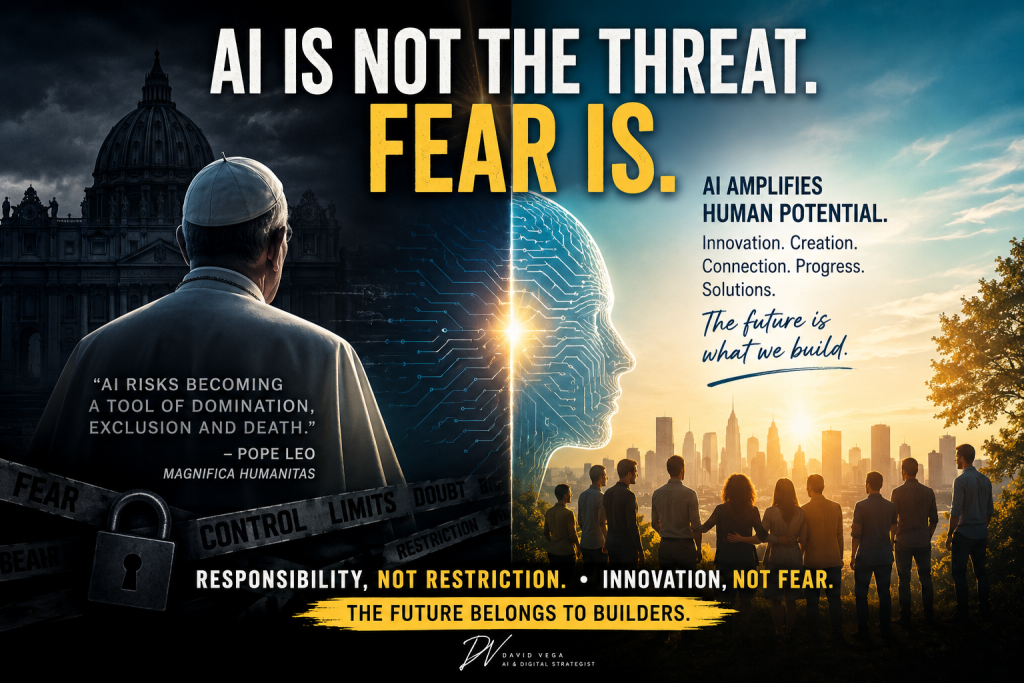

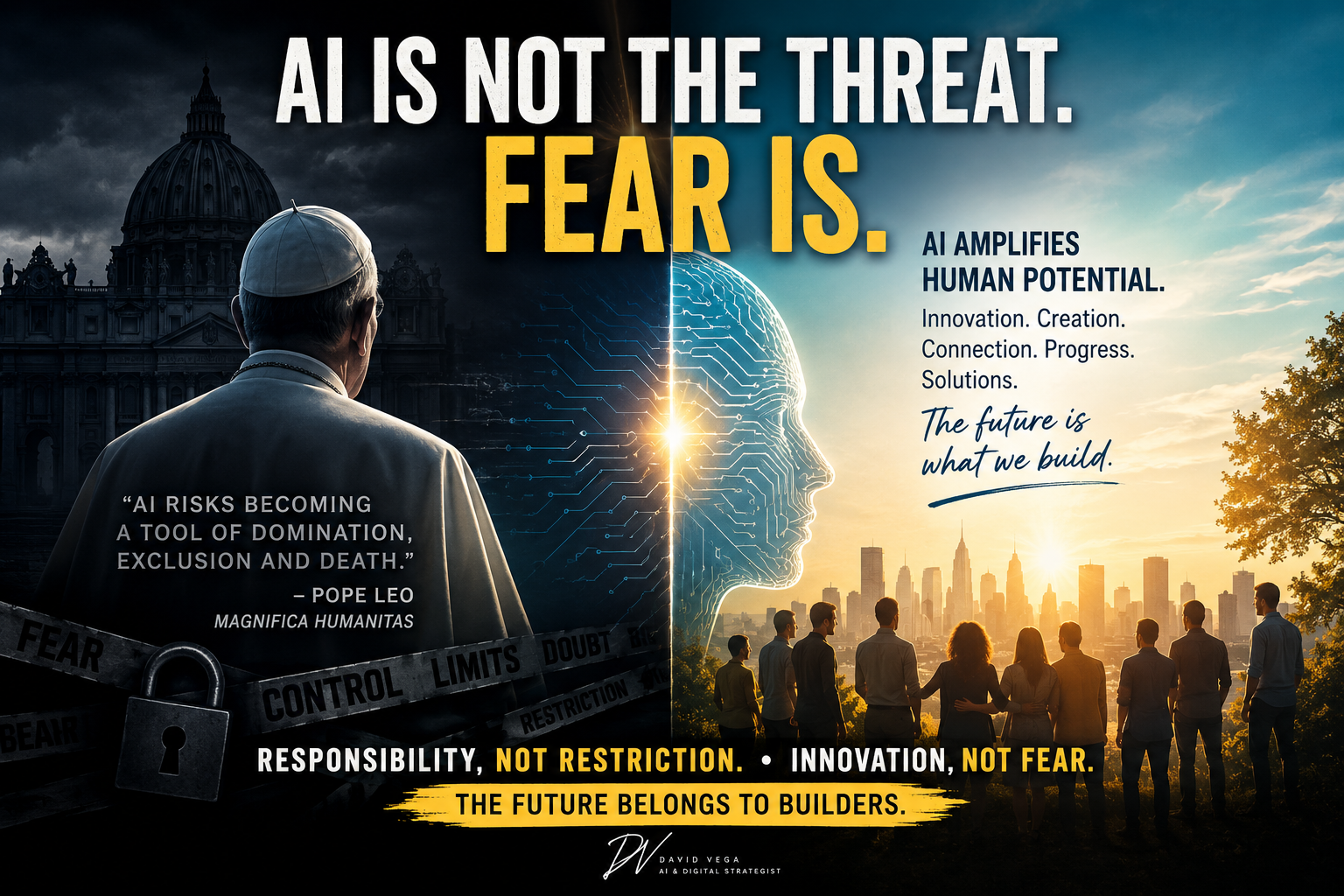
Artificial intelligence is once again being framed as a threat to humanity. This time, from one of the most powerful institutions in the world. Pope Leo recently unveiled the Vatican’s new encyclical Magnifica Humanitas, warning that artificial intelligence could become a tool of “domination, exclusion and death” unless governments step in with moral limits.
That language is dramatic. Heavy. Emotional.
And it deserves a closer look.
As someone who has spent decades in digital innovation, marketing technology, and AI systems, and has helped businesses evolve with technology, I see this very differently.
AI is not the threat. People without vision, poor leadership, bad incentives, and institutions afraid of losing relevance are the threat.
That distinction matters.
AI Is a Tool. Nothing More and Nothing Less.
Artificial intelligence doesn’t wake up and decide to dominate.
It doesn’t create exclusion on its own.
It doesn’t choose destruction.
Humans do.
AI reflects the systems we build around it. It mirrors our data, our goals, our ethics, our leadership, and our intentions.
A hammer can build a home.
A hammer can also break a window.
The tool isn’t the villain.
The hand behind it is.
The conversation should not begin with fear. It should begin with responsibility, transparency, access, and innovation.
Fear Has Always Followed Innovation
History repeats itself.
The printing press was feared.
Electricity was feared.
Television was feared.
The internet was feared.
Search engines were feared.
Social media was feared.
Now AI.
Every transformative technology arrives with skepticism.
Every time.
And nearly every time, institutions with established power structures respond by attempting to regulate what they do not yet fully understand.
Sometimes that comes from good intentions.
Sometimes it comes from self-preservation.
Sometimes it’s both.
Let’s Talk About Political Theater Around AI
There’s another side to this conversation that few want to say out loud.
AI is disrupting authority.
It’s decentralizing access to knowledge.
It allows individuals, creators, entrepreneurs, students, and small businesses to do things once reserved for governments, universities, corporations, publishers, and legacy institutions.
That changes power.
And when power shifts, resistance usually follows.
That resistance often gets packaged as “protection.”
Protection of humanity.
Protection of morality.
Protection of culture.
Protection of truth.
Sometimes those concerns are valid.
Other times it feels more like institutional panic dressed as moral guidance.
The question worth asking is this:
Are we protecting people from AI?
Or
Are we protecting institutions from what AI empowers people to become?
That’s a very different debate.
AI Is Already Creating Extraordinary Human Good Every day:
AI is helping doctors diagnose diseases faster.
Helping scientists discover proteins and medical breakthroughs.
Helping disabled individuals communicate.
Helping students learn.
Helping businesses grow.
Helping nonprofits scale impact.
Helping creators bring ideas to life faster than ever before.
Helping small teams compete with giants.
Helping humanity solve problems at a scale we’ve never seen.
At Tridence, we see it every day. AI isn’t replacing human creativity. It’s amplifying it.
It isn’t removing human intelligence.
It’s extending it.
The Future Needs Ethics. But It Also Needs Courage.
Yes, AI needs guardrails.
Yes, transparency matters.
Yes, ethics matter.
Absolutely.
But fear should not become policy.
Panic should not become regulation.
And institutions should not become gatekeepers of innovation simply because the speed of change feels uncomfortable.
The future belongs to the builders.
The educators.
The thoughtful innovators.
The people are willing to shape AI responsibly instead of fearing it from a distance.
AI doesn’t remove humanity. It reveals it.
And what we do next with it says more about us than it ever will about the machines themselves.
The real risk isn’t artificial intelligence.
The real risk is human intelligence choosing fear over progress.
David Vega
CEO, Tridence
AI & Digital Strategist, Creator of Signal Engagement Optimization™
(tridence.com)