
I have spent 30 years building digital businesses, and I have never seen a moment quite like this one. A founder can describe an idea in plain English and watch a working interface appear in minutes. Cloud platforms promise instant, serverless execution with no backend to manage. The industry calls it “vibe coding,” and I understand the excitement.
Speed is valuable. Permanence is what builds an enterprise.
That is the question I ask every client now: when the excitement fades, what do you actually own?
The Real Cost of Vibe Coding: Comprehension Debt
Vibe coding shines in the early hours of a project. You describe an intent, an AI agent writes the scripts, and a prototype appears. It is a remarkable way to test an idea.
A prototype and a production system are two different animals, though. Rapid prompting creates something I call comprehension debt: software that exists while no one truly understands how it operates. When a human architect builds a system, that person knows its failure modes, its state management, and its bottlenecks. When a system emerges from dozens of natural language iterations, nobody holds that map.
Then an edge case hits production. Suddenly you have a black box that costs more tokens to troubleshoot than it cost to generate. Three vulnerabilities tend to surface:
- Obscured security boundaries. AI-generated code can introduce outdated libraries, hardcoded credentials, and weak input sanitization. Without human architectural oversight, your attack surface grows quietly.
- Fragile dependency cascades. As features stack up, generated code can create circular dependencies and bloated routines that slow server execution.
- Unmaintainable debug cycles. When an unvetted script fails under heavy concurrency, more prompting rarely finds the root cause. Teams can lose weeks untangling problems that deliberate design would have prevented.
The Proprietary Host Trap: Who Controls Your Data?
Closed LLM hosting platforms make a compelling promise of frictionless deployment. Here is what that convenience can cost you when your application stack depends on a proprietary runtime and black-box backend generation:
- You lease the execution layer. Model drift, API deprecation, or a licensing shift upstream can break your core pipeline overnight.
- You lease your schema. Data scattered across proprietary vector stores and third-party SaaS silos becomes hard to consolidate, audit, or move.
- You lease operational continuity. Speed arrives on day one, and vendor lock-in follows on day 500.
| Closed AI / LLM Platforms | Open Architecture (Self-Hosted) |
|---|---|
| Proprietary data schemas | Relational MariaDB/MySQL data you control |
| Black-box execution layers | Full PHP, Python, and JavaScript scripting authority |
| Upstream token and API shifts | Dedicated VPS or bare metal of your choosing |
| Vendor lock-in and lease model | Portable, zero-license asset |
Schema Portability
When customer records, workflows, and product engines live inside a closed ecosystem, your data is tethered to that vendor’s storage model. If the platform changes pricing, tightens its terms, or sunsets the product, your exit costs can become astronomical.
Deterministic Execution
A mature open-source stack, such as WordPress on enterprise Linux with MariaDB, delivers predictable results. Your queries, object caches, and server responses behave the same way every time. Closed AI runtimes bring model drift, variable latency, and token consumption spikes that can strain an operating budget.
Intellectual Property and Scripting Rights
Custom server scripts, API endpoints, and database hooks are yours. Renting ephemeral functions on a vendor’s cloud means building on ground that can shift beneath you.
The Three Sovereign Layers of True Ownership
Real enterprise ownership rests on three layers you control:
- The database schema (MariaDB/MySQL), where every transaction, post, user interaction, and taxonomy lives in an open relational format you can back up, encrypt, export, or mirror at any time.
- The application engine, where you hold direct authority over how PHP, Python, and JavaScript execute, and you tune every cycle for memory and page-load speed.
- The server environment (Linux, LiteSpeed, NGINX), where you choose your hypervisor, control panel, and caching architecture. You can move from a regional VPS to dedicated bare metal without rewriting a single line of business logic.
Together they give you portable code, total scripting authority, sovereign audit trails, and deterministic performance.
Open Architecture Amplified by AI
I am a champion of artificial intelligence. I build with it every day. The strongest results come when AI accelerates a foundation you already govern.
Modern teams use AI agents to optimize database queries, automate metadata tagging, and analyze traffic signals. Those agents deliver the most value when they work inside an established, human-governed system of record. You keep the architecture, and the AI multiplies your output.
Why This Matters for SEO 3.0 and AI Visibility
This conversation belongs in every marketing leader’s playbook, because ownership and visibility are connected.
SEO 3.0, the evolution of Signal Engagement Optimization™ that I introduced at Tridence, recognizes that search engines and AI platforms rank brands on how real people engage with content across the entire digital ecosystem. Visibility now depends on signal strength: intent-driven content, engagement across web, social, and AI platforms, brand mentions and citations in AI-generated answers, and behavioral signals like time on site, interaction depth, and return visits.
Consider what that requires from your infrastructure:
- Clean, structured, crawlable content that AI systems can interpret and trust.
- Fast, stable performance that supports the behavioral signals AI platforms observe.
- Complete control of your data and analytics so you can measure engagement and act on it.
- A consistent, portable brand presence that no vendor can switch off.
A self-hosted open architecture gives you all four. It is the foundation that lets your signals compound over time.
This is also why I built Signal Scanner. Its AI Visibility Diagnostics reveal how ChatGPT, Gemini, Perplexity, and other AI engines interpret and represent your brand. When you own the platform your content lives on, you can act on those insights immediately, fixing structure, strengthening entities, and publishing with confidence.
The Long Game of Digital Enterprise
Convenience is a wonderful accelerator, and it makes a poor foundation. Vibe coding and managed LLM environments are excellent for weekend projects and rapid experiments. Enterprise stability calls for structural discipline.
Owning your architecture, your data structures, and your server logic is the surest way to protect your brand from platform volatility. Invest in an open, portable ecosystem, layer AI on top to move faster, and measure your signals so you can grow with intention.
When you control your foundation, you set the terms of your growth.
Where does your business stand today? Audit your stack, identify what you own and what you rent, and see how AI systems currently represent your brand. If you want a clear picture, run an AI Visibility Diagnostic at signalscanner.io and let’s build your signal strength from a foundation you control.
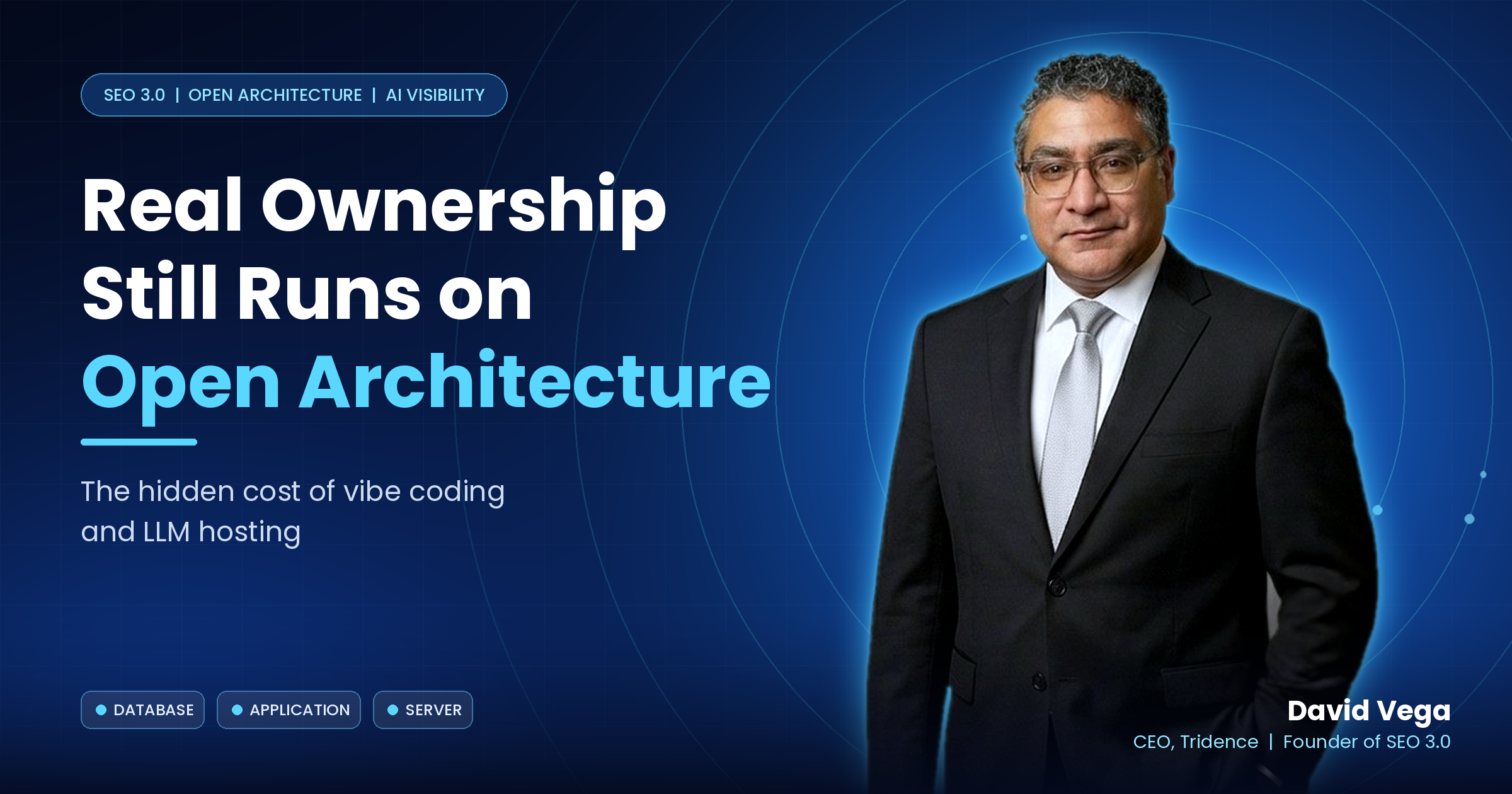
David Vega is the CEO of Tridence and the founder of SEO 3.0. He is the creator of Signal Scanner and an AI Growth Architect with 30 years of experience helping brands earn visibility and trust.