

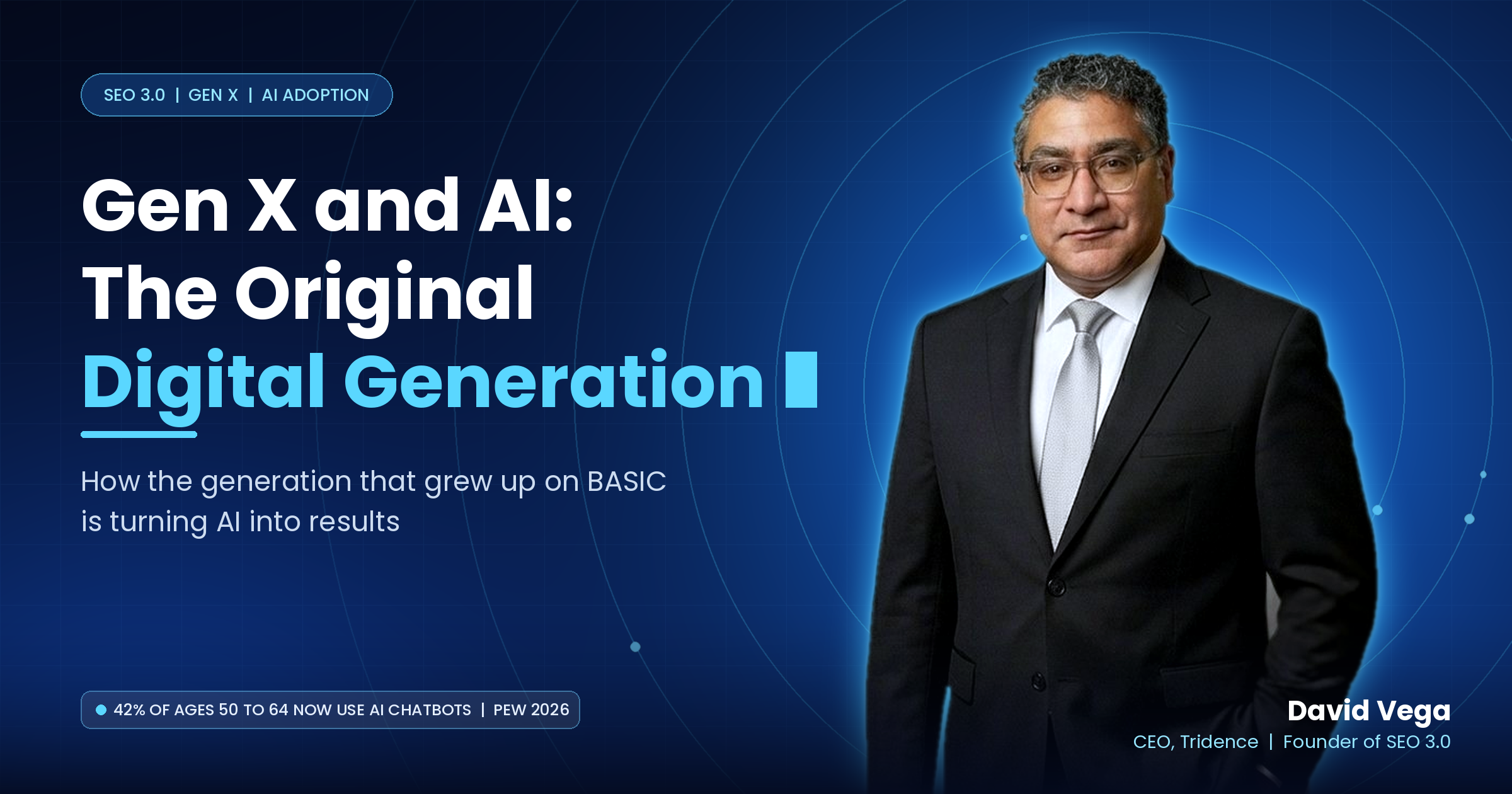
In 1982, a kid sat down at a Commodore 64 and faced a blinking cursor. No tutorial. No app store. No one to ask. The kid typed a few lines of BASIC, pressed Enter, and the machine did exactly what it was told.
That blinking cursor is back. It now lives inside a chat window, and millions of people are typing plain-language instructions into it. Anyone who grew up on that Commodore recognizes the feeling right away.
I have spent 30 years in digital business, and every technology wave has shown me the same pattern. Generation X meets the new tool early, tests it hard, and puts it to work. AI is following that path.
So is Gen X adopting AI? The data says yes, and the details make the story worth telling.
Is Gen X Using AI?
Yes, and the climb is steep. Pew Research Center’s 2026 survey found that 42% of Americans aged 50 to 64, a group made up mostly of Gen X, now use AI chatbots. In 2024, that figure was 25%. ChatGPT use in the same age group rose from 13% in 2023 to 37% in 2026, nearly tripling in three years.
A 2026 Ipsos survey commissioned by the workforce nonprofit CWI Works found that 71% of Gen Xers have used generative AI, compared with 74% of Millennials. The early signs go back further. In January 2023, weeks after ChatGPT launched, a Fishbowl survey of 4,500 professionals found 28% of Gen X respondents already using generative AI at work, nearly matching Gen Z at 29%.
Here is how each age group moved between 2024 and 2026, according to Pew:
| Age group | Used AI chatbots in 2024 | Used AI chatbots in 2026 | Change |
|---|---|---|---|
| 18 to 29 | 55% | 66% | +11 points |
| 30 to 49 | 41% | 61% | +20 points |
| 50 to 64 | 25% | 42% | +17 points |
| 65 and older | 12% | 23% | +11 points |
Younger adults still lead in total usage. Adults aged 50 to 64 gained 17 points in two years, a bigger jump than adults under 30 or adults 65 and older. Gen X is gaining ground, and the trend line points up.
Why Is Gen X Ready for AI?
Pew defines Generation X as people born from 1965 to 1980, and describes a generation that came of age as the computer revolution took hold. The timeline backs that up:
- August 1982: The Commodore 64 goes on sale for $595. It ships with BASIC and becomes the best-selling desktop computer of all time, according to Guinness World Records.
- 1993: Marc Andreessen, born in 1971, co-creates the Mosaic browser, which helped bring the web to a mass audience.
- 2019: Pew finds that 90% of Gen X owns a smartphone, within three points of Millennials at 93%.
The pattern repeats with the personal computer, the web, mobile, social, and the cloud. Each wave arrived when Gen X was young enough to experiment and established enough to build careers and companies around it. AI is the next wave on the list.
Here is the analogy I keep coming back to. Programming in BASIC was a conversation. You gave the machine a clear instruction, watched what came back, fixed your mistake, and tried again. Prompting an AI follows the same loop: clear input, honest review, steady refinement. Gen X practiced that loop for decades before machines could answer in full sentences.
Gen X also brings a second advantage, which I call digital bilingualism. This generation remembers life before the internet and built careers after it. Bilingual people make strong translators, and AI needs translators who can tell excellent output from confident nonsense. The Mather Institute’s Gen Xperience Study positions Gen X to encourage Boomers to use AI and to serve as a voice of caution on fact-checking what AI produces.
Is Gen X Afraid of AI?
The data points to cautious confidence. In Pew’s 2026 survey, 28% of adults aged 50 to 64 expected AI to affect them negatively over the next 20 years, compared with 37% of adults aged 18 to 29. Another 24% of the older group expected a positive effect, compared with 20% of the younger group.
Gen X keeps a clear eye on the risks. Between 61% and 65% of every age group in Pew’s survey said AI is advancing too quickly. SurveyMonkey’s generational research ties Gen X hesitation about personal AI use to privacy and accuracy concerns.
I read that as a strength. Caution paired with action is how experienced professionals adopt tools that matter.
Does Gen X Lead the Companies Building AI?
Gen X leaders sit at the helm of Microsoft, Google, and Google DeepMind. Satya Nadella, born in 1967, leads Microsoft. Sundar Pichai, born in 1972, leads Alphabet and Google. Demis Hassabis, born in 1976, leads Google DeepMind and shared the 2024 Nobel Prize in Chemistry for AI work on protein structure.
Gen X also holds the wallet. NielsenIQ estimates Gen X spending at $15.2 trillion globally in 2025 and projects $23 trillion by 2035.
Where Is the Gap, and What Closes It?
Confidence and training trail curiosity. Only 12% of adults aged 50 to 64 say they feel very confident using chatbots, according to Pew. AARP Research found that only 12% of workers 50 and older have taken an AI class, and 63% say their employer is not doing enough. Interest runs high, with 49% of those workers wanting training. In the Ipsos survey, 41% of Gen Xers said they are very or extremely interested in learning AI and digital skills.
The appetite is real, and the path forward belongs to leaders. Microsoft’s 2026 Work Trend Index, a survey of 20,000 AI users, found that culture, manager support, and talent practices account for about twice the impact of individual mindset and behavior (67% versus 32%). AI fluency grows in the environment leaders build. Gen X leaders hold the authority to build it.
What Does Gen X AI Adoption Mean for SEO 3.0?
SEO 3.0, the evolution of Signal Engagement Optimization™ that I introduced at Tridence, holds that search engines and AI platforms recommend brands based on how real people engage with them across the entire digital ecosystem. When 42% of Americans aged 50 to 64 use AI chatbots and Gen X controls trillions in spending, the answers those chatbots give start to shape real buying decisions.
That is where signal strength matters. AI systems cite the brands they can interpret and trust, and trust comes from clear content, consistent mentions, and real engagement. Three moves to make now:
- Answer the questions experienced buyers ask. Write with substance, evidence, and a direct point of view.
- Build consistent signals across web, social, and AI platforms. Show up everywhere your audience looks for answers.
- Measure how AI describes your brand. Signal Scanner’s AI Visibility Diagnostics reveal how ChatGPT, Gemini, and Perplexity interpret and represent you.
Frequently Asked Questions
What percentage of Gen X uses AI?
Pew’s 2026 survey found 42% of Americans aged 50 to 64, mostly Gen X, use AI chatbots. A 2026 Ipsos survey found 71% of Gen Xers have used generative AI. The two surveys ask different questions of different age groups, which explains the gap between the numbers.
Is Gen X afraid of AI?
The data shows cautious confidence. In Pew’s 2026 survey, 28% of adults aged 50 to 64 expected a negative personal impact from AI, compared with 37% of adults aged 18 to 29.
Why does Gen X AI adoption matter for marketers?
Gen X spending reached an estimated $15.2 trillion globally in 2025, according to NielsenIQ. As this generation adopts AI chatbots, the brands those tools recommend gain an advantage.
The Cursor Is Blinking Again
Gen X has never waited for permission to try the next machine. The personal computer, the web, and the smartphone each earned a place in this generation’s toolkit, and AI is taking its seat beside them.
Where does your brand stand when a Gen X buyer asks an AI for a recommendation? Run an AI Visibility Diagnostic at signalscanner.io and find out. Then let’s build your signal strength together.
David Vega is the CEO of Tridence and the founder of SEO 3.0. He is the creator of Signal Scanner and an AI Growth Architect with 30 years of experience helping brands earn visibility and trust.
Sources
- Pew Research Center, How opinions and use of AI differ by age (2026)
- Pew Research Center, Majorities of adults under 50 now use ChatGPT
- Pew Research Center, Where Millennials end and Generation Z begins (2019)
- Pew Research Center, U.S. generations and technology use (2019)
- Ipsos for CWI Works, survey results (2026)
- Fishbowl via Statista, Generative AI adoption at work by generation (2023)
- Mather Institute via HR Dive, Gen X may be pivotal in bridging generations at work
- SurveyMonkey, AI trends by generation
- AARP Research via American Society on Aging, Older workers, AI, and the data behind adoption (2026)
- Microsoft, 2026 Work Trend Index
- NielsenIQ, Gen X emerges as the most influential global consumer cohort (2025)
- Guinness World Records, Most computer sales
- Nobel Prize, Demis Hassabis facts